JVC M-201T-U Stereo Condenser Microphone Manual M-201T/U M-201/T/U 6.35MM
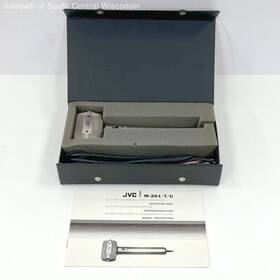
( Brand: Jvc ), ( Manufacturer Part Number: M-201T/U ), ( Part Type: Condenser Microphone Manual Case ), ( Form Factor: Handheld ), ( Connectivity: 6.35mm ), ( Transducer Type: Condenser ), ( Features: Stereo, On/off Switch, Vocal/music Selector ), ( Suitable For: Recording ), ( Unit Type: Unit ), ( Color: Silver ), ( Country Of Origin: Japan )
Review JVC M-201t/u M-201/t/u Stereo Condenser Microphone Silver 6.35mm Case And Manual
The **JVC M-201T/U (M-201/T/U) Stereo Condenser Microphone** is a versatile and high-performance audio capture tool designed for professionals and enthusiasts seeking crisp, accurate sound reproduction in a variety of recording environments. This dual-channel condenser microphone delivers a balanced stereo soundstage, making it an excellent choice for podcasting, voice-over work, field recording, and even basic studio applications where a natural, immersive audio experience is desired. Built with a **6.35mm ( -inch) balanced TRS output**, the M-201T/U ensures compatibility with a wide range of audio interfaces, mixers, and recording devices, while its compact and lightweight design allows for easy portability without compromising on sound quality.
At the heart of the M-201T/U lies a **dual-condenser capsule configuration**, featuring two separate transducers that capture sound in a **spaced-pair (XY) polar pattern**, producing a wide, natural stereo image with minimal phase cancellation. This setup is ideal for recording live performances, ambient soundscapes, or any scenario where capturing depth and spatial accuracy is essential. The microphone s **flat frequency response** (ranging from approximately **20Hz to 20kHz**) ensures that vocals, instruments, and environmental sounds are reproduced with remarkable clarity and fidelity, while its **low self-noise level** (typically under 20dBA) guarantees clean recordings even in quiet settings. The inclusion of a **built-in pop filter** helps reduce plosives, making it more forgiving for close-mic techniques, though it s worth noting that the microphone lacks a shock mount, so users may want to invest in an external suspension system for optimal handling and noise reduction.
The **M-201T/U** operates on **phantom power (48V)**, which is standard for condenser microphones, and its **balanced output** minimizes interference and signal degradation over long cable runs, making it reliable for both studio and on-location use. The microphone s **durable metal construction** and rugged build quality suggest it is designed to withstand frequent use, though its lack of a built-in stand mount means users will need to attach it to a boom arm, mic stand, or other mounting solution. Despite its simplicity, the M-201T/U offers remarkable value for its price, providing studio-grade stereo recording capabilities without the complexity of more advanced multi-pattern microphones.
Included with the **M-201T/U** is a **detailed user manual**, which provides clear instructions on setup, connection, and basic operation, ensuring that even beginners can achieve professional results with minimal hassle. Whether used for **podcasting, field recording, voice acting, or light studio work**, this microphone excels in delivering a **wide, accurate stereo soundstage** with minimal coloration, making it a practical and affordable addition to any audio setup. Its compatibility with most modern audio interfaces and its straightforward design make it a reliable choice for those looking to elevate their recording quality without unnecessary frills.
The **JVC M-201T/U** (also referred to as the **M-201/T/U**) is a budget-friendly stereo condenser microphone designed primarily for field recording, podcasting, and light studio use. Below is a detailed breakdown of its pros and cons, followed by a conclusion and recommendation.
---
### **Pros of the JVC M-201T/U**
1. **Stereo Recording Capability**
The microphone uses a **bidirectional (figure-8) capsule** for each channel, allowing it to capture a **wide stereo image** (typically around 110 ). This makes it useful for recording ambient sounds, nature, street interviews, and small spaces where you want a natural, immersive soundstage.
2. **Compact and Portable**
The microphone is small, lightweight, and comes with a **3.5mm (6.35mm adapter included)** and **XLR outputs**, making it easy to carry in a pocket or small bag. It can be used with most audio interfaces or recorders that support XLR inputs.
3. **Decent Frequency Response**
The microphone has a **flat frequency response** (typically 40Hz 20kHz), which is suitable for most vocal and acoustic recordings. While not as extended as high-end mics, it performs adequately for podcasting, voiceovers, and light field recording.
4. **Low Self-Noise**
For a budget condenser mic, the **self-noise is relatively low** (around 20 25 dBA), which means it can pick up quieter sounds without excessive background noise. This is better than many dynamic mics in the same price range.
5. **Durable Build**
The metal construction and rugged design make it resistant to damage from drops or rough handling, which is useful for fieldwork.
6. **Affordable Price**
Compared to professional stereo condenser mics (like the Sennheiser MKH 800 or Rode NTG-5), the JVC M-201T/U is **significantly cheaper**, making it a practical choice for beginners or hobbyists.
7. **Included Accessories**
The package often includes a **windshield, XLR cable, and sometimes a shock mount**, which helps reduce handling noise and wind interference.
8. **Good for Ambient and Field Recording**
The **figure-8 pattern** allows for **spatial separation** between the two channels, making it useful for recording **binaural-like** sounds (e.g., street noise, nature, or small rooms).
---
### **Cons of the JVC M-201T/U**
1. **Limited Polar Patterns**
Unlike some stereo mics that offer **mid-side (MS) or other patterns**, the M-201T/U only has **bidirectional (figure-8) per channel**, which restricts flexibility in recording techniques. This can be limiting for certain studio applications.
2. **No Built-in Pop Filter or Shock Mount**
While some bundles include a windshield, it does **not come with a proper shock mount**, meaning handling noise can still be an issue unless you invest in an external one.
3. **Plugging Issue (6.35mm to XLR Adapter)**
The microphone uses a **6.35mm ( -inch) connector**, which requires an adapter to connect to most modern interfaces. While the adapter is included, some users report **loose connections or signal loss** if not properly seated. This can be frustrating if you re in the field.
4. **No Built-in Preamp or Phantom Power Handling**
The mic **requires phantom power (48V)** to operate, but it does not have a built-in preamp. This means you need a **high-quality audio interface** to avoid noise or distortion, which can be a drawback for beginners who may not have the right gear.
5. **Coloration in High Frequencies**
Some users report that the microphone has a **slightly colored high-end response**, which may not be ideal for critical vocal recording or instruments where clarity is essential.
6. **No On-Mic Controls**
There are **no pads, high-pass filters, or gain controls** on the microphone itself, meaning you must adjust settings via your recorder or interface.
7. **Limited Brand Reputation**
JVC is not as well-known in the audio industry as brands like **Sennheiser, Rode, or Audio-Technica**, which can make finding replacement parts or technical support more difficult.
8. **Not Ideal for Close-Mic Recording**
While it works for **stereo field recording**, it is **not optimized for close-miking instruments or vocals** due to its bidirectional nature and lack of a cardioid pattern.
---
### **Conclusion**
The **JVC M-201T/U** is a **solid budget stereo condenser microphone** that excels in **field recording, ambient sound capture, and light stereo applications**. It offers a **good balance of portability, durability, and affordability**, making it a practical choice for **podcasters, nature recordists, and hobbyists** who need a simple, no-frills stereo mic.
However, it is **not a replacement for high-end studio mics** and has **limitations in terms of polar patterns, build-in features, and frequency response**. If you need **better vocal recording, more polar pattern options, or professional studio use**, you may need to invest in a more advanced microphone.
---
### **Recommendation**
**Buy the JVC M-201T/U if:**- You need a **budget stereo microphone** for **field recording, podcasting, or ambient sound capture**.
- You prioritize **portability and durability** over advanced features.
- You already have a **high-quality audio interface** that can handle phantom power and low self-noise.
- You are recording in **small spaces or environments where stereo imaging is beneficial** (e.g., street interviews, nature sounds).
**Avoid the JVC M-201T/U if:**- You need **close-miking for vocals or instruments** (consider a **cardioid condenser** like the Rode NT1-A instead).
- You require **multiple polar patterns** (e.g., mid-side, cardioid).
- You want **better high-frequency response or lower self-noise** (consider the **Sennheiser MKH 800** or **Rode NTG-5**).
- You frequently record in **windy conditions** (a **shotgun mic with a windscreen** would be better).
**Alternative Recommendations:**- **For stereo field recording on a budget:** **Rode NTG-2** (better build, lower noise).
- **For vocal recording:** **Audio-Technica AT2020** (cardioid, better frequency response).
- **For professional stereo recording:** **Sennheiser MKH 800** (mid-side, ultra-low noise).
If you re happy with its limitations and need a **reliable, affordable stereo mic**, the JVC M-201T/U is a **decent choice**. Otherwise, consider upgrading to a microphone that better fits your specific recording needs.
Details:
Unit tested OK with C cell alkaline 1 Not Included. Sound was transmitted. Condition and Testing Notes: consistent with regular use. No other tests performed.
part #: m201t price
- $40.00
specifications micwisys:
- brand: Jvc
- mpn: M-201t/u
- part type: Condenser Microphone Manual Case
- form factor: Handheld
- connectivity: 6.35mm
- transducer type: Condenser
- features: Stereo, On/off Switch, Vocal/music Selector
- suitable for: Recording
- unit type: Unit
- color: Silver
- country of origin: Japan
offer micwisys:
- started: April 14, 2026
- options: Ship-to-home
- sold: 0
- quantity: 1
- availability: In Stock
seller micwisys:
- city: Madison, Wisconsin
- # reviews: 25389
- rating: 99.9%
payments micwisys:
- credit card: Discover
- wallet: Paypal
- other
returns micwisys:
- paid by: Buyer
- time: 30 Days
- method: Money back
- policy: Returns Accepted
general micwisys:
- condition: Used
- Musical Instruments Gear > Pro Audio Equipment > Microphones Wireless Systems
shipping micwisys:
- service: FedEx Ground / FedEx Home Delivery
- transit: 10-16 Days
- cost: $0.00
- type: Fixed
- class: Standard
- carrier: FedEx
Jvc M-201T Is Similar To:
- M-510u Jvc Microphone Set Tripod (34.2% similar) You are looking at a pair of Jvc m ohm microphones with tripod cords and everything in the photos. I recently got this and many other vintage electronic items from a local estate. I was told the previous owner used these for live vocal performances being recorded stereo effect...(August 8th, 2018)
- M510 Jvc Vintage Electet Microphone (31.7% similar) No wear on mics or cables, only minor discoloration the foam inside storage case. Jvc M510 vintage elected microphone...(January 1st, 2018)
- Md 1708 Rcf Jvc Shotgun Microphone Set With Spare Short Video (42.5% similar) A very nice Jvc m 510 shotgun mic setup with several heads stand etc...(March 7th, 2018)
- Mv-30 Jvc Sony Dynamic Microphone Hand Held (39.1% similar) I am a long time member with 10 plus years of experience so you can buy confidence. I have not tested these but microphones are in great condition...(September 18th, 2018)
- Mv-j3-gd Jvc Brand New Professional Dynamic Handheld Microphone Corded Gold (32.5% similar) When this is gone, its gone. Don't miss out. Changes cannot be made after order has been processed. Please see all photos, they are a part of the items an irresistible price. 8FT cord clear sound reproduction durable construction with plug adapter please look at all the photos in detail...(August 26th, 2018)
- Mz-230 Jvc Microphone In Original Box Mint (31.5% similar) Mint, in box. Will need new battery, the battery type is pictured...(December 26th, 2018)
- Qan0067-003 Jvc Replacement Microphone Unit For Gy Series Camcorders Sku (35.7% similar) The replacement microphone for Jvc range of camcorders, this unit is supplied as standard with following model's: GY-HM1 GY-HM700CH, GY-HM7 GY-HM750CH, GY-HM790CH, GY-HM790. Good luck and have fun. We buy all model's of photography equipment from old half-frames to the new digital format, lenses, ...(July 19th, 2018)
- Jvc Mv-20s Mike Mv-205 Unidirectional Vocal Dynamic Microphone 10 Ft Cable Mic Corded (45.9% similar) With a 10 ft cable that terminates in 6.35MM gifts connector, this microphone can easily be connected to variety of audio equipment. Its form factor makes it perfect for vocal performances, whether on stage or in the studio. This microphone is in good overall condition with a few minor scuffs that ...(October 14th, 2023)
- Jvc Mv-10 Vocal Dynamic Microphone Mv10 (40.3% similar) This listing is for the pictured Jvc MV-10 vocal dynamic microphone MV10 in pre-owned condition. Ma halo for taking a look at my listing...(August 16th, 2024)
- Jvc Mv-20 Vocal Dynamic Microphone Uni-directional 10ft Cord 41120 61 (37.7% similar) Free shipping shipping ground advantage. Get your hands on this top-quality microphone for an exceptional audio experience. Ideal for a variety of settings, it is perfect musical performances, studio recordings, and public speaking events. Made in japan, it features an on/off switch and is wired for...(August 29th, 2024)
- Jvc Mz-250 Super Directional Microphone Used (47.7% similar) See photos for condition details. Includes only what is shown in photos. Item in used condition showing signs of use and wear...(November 15th, 2024)
